Shopping Cart
There are no more items in your cart
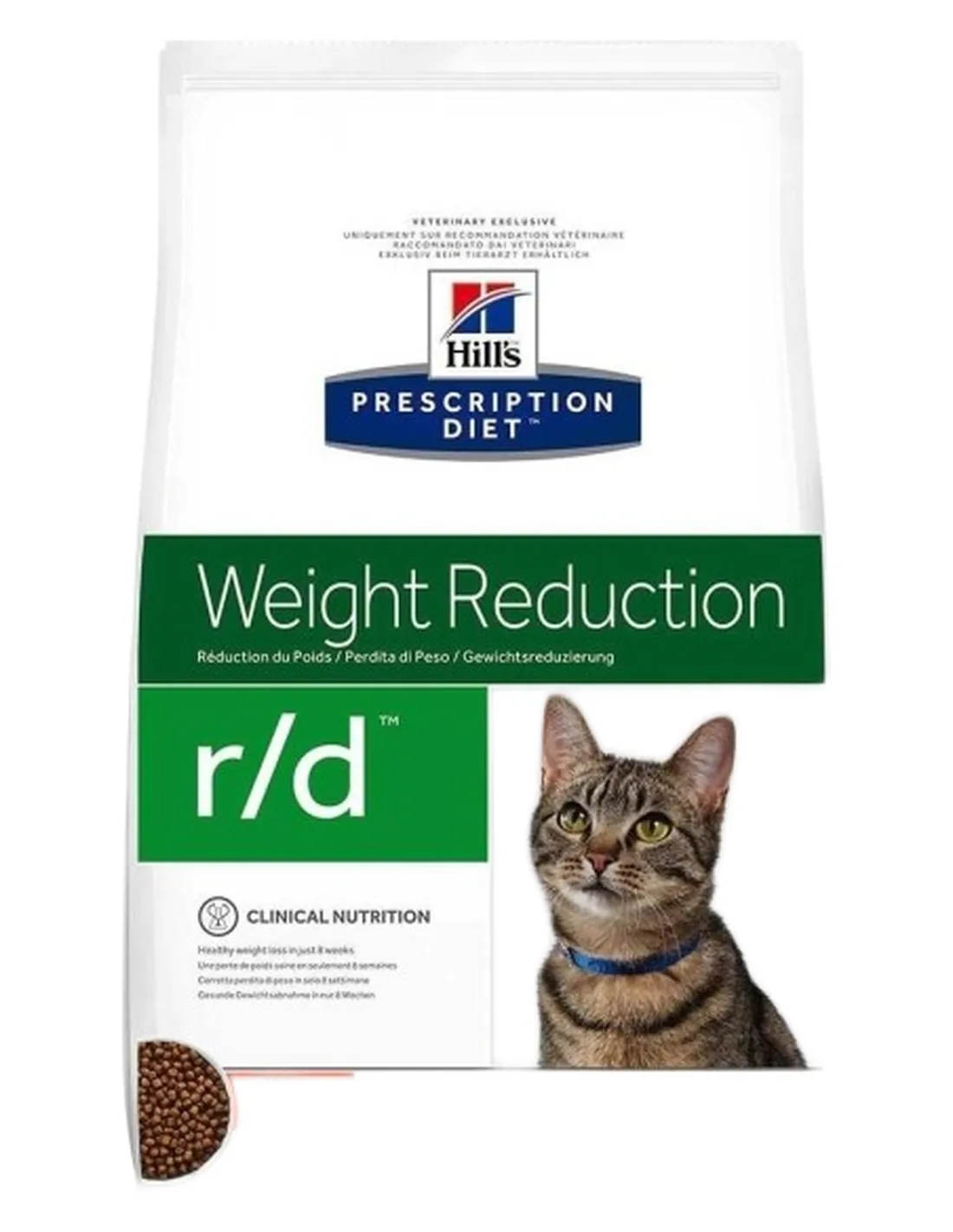


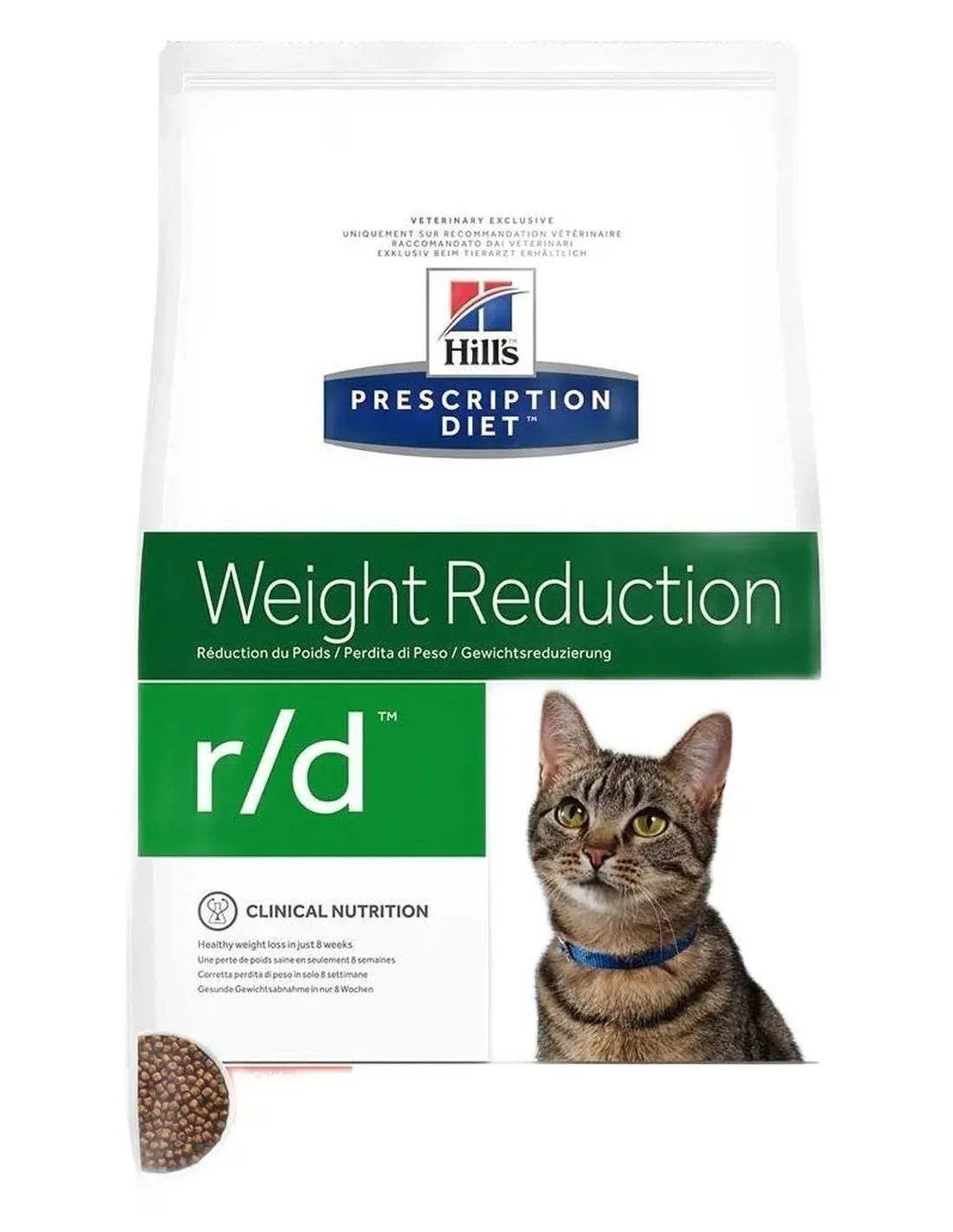
Prescription Diet™ r/d™ Feline
Recommended for:
- Overweight cats.
- Fiber-responsive disorders in overweight cats: diabetes mellitus, colitis and constipation.
- Hyperlipidemia.
Not recommended for:
- Kittens.
- Pregnant or breastfeeding females.
- Debilitated or underweight cats, dehydrated or with increased energy needs.
More information
Weight reduction
- A realistic body weight loss is approximately 1% weekly.
- The indicated quantities to be administered sometimes need to be decreased to produce optimal weight loss.
- It is necessary to obtain the owner's full collaboration and strictly control the food intake. Hill's offers the customer all the information to achieve effective weight loss; contact your Hill's Scientific Representative for further details and assistance.
- After reaching ideal body weight, it is recommended to give your dog Prescription DietTM w/d™ Feline to maintain it.
- Do not allow an obese cat to fast for more than 2-3 days as this could increase the risk of hepatic lipidosis.
- Do not administer urinary acidifiers
Constipation
- Ensure a sufficient supply of water
| KEY FEATURES3 | KEY BENEFITS | |
|---|---|---|
| Energy Fats |
Low levels | The accumulated body fat is used to meet energy needs and therefore weight loss occurs. |
| Fibre | High levels | Excess weight: offers greater food bulk which helps increase satiety and reduce hunger. Diabetes mellitus: Helps minimize blood glucose fluctuations which can help reduce insulin dosage. Colitis: changes intestinal transit times. Constipation: stimulates intestinal motility. |
| L-Carnitine | Integrated | Facilitates the conversion of fats into energy. Helps maintain lean muscle mass. |
| L-lysine | Integrated | Helps preserve lean muscle mass |
| Superior Antioxidant Formula | Addition | Helps neutralize free radicals which can increase in overweight animals. |
DAILY QUANTITY
These dosages are to be considered indicative, as cats' needs change. 1,2 Adjust doses in order to maintain ideal body weight.
For weight loss: Determine the amount to be administered based on your target weight rather than your current weight.
For weight control: Patients should be monitored to ensure that optimal body weight is maintained. Increase the quantity of food accordingly.
When feeding the food for the first time, mix increasing doses of the new food with decreasing doses of the previous food over a 7 day period.
| Weight loss Ideal Body weight in kg |
Grams of dry |
|---|---|
| 2 | 30 |
| 3 | 40 |
| 4 | 50 |
| 5 | 60 |
| 6 | 70 |
| 7 + | 10 per kg |
A 156g can corresponds to 40 grams of dry product.9
| FOR ALL THE OTHERS INDICATIONS Body weight in kg |
Grams of dry |
|---|---|
| 2 | 40 - 50 |
| 3 | 50 - 70 |
| 4 | 65 - 85 |
| 5 | 75 - 105 |
| 6 | 85 - 120 |
| 7 + | 15 per kg |
| ADMINISTRATION GUIDE FOR WEIGHT LOSS |
||
|---|---|---|
| Target Body weight in kg |
Cans 156 g | Grams of dry |
| 2 | 1/2 | 10 |
| 3 | 1/2 | 20 |
| 4 | 1 | 10 |
| 5 | 1 | 20 |
| 6 | 1 | 30 |
| 7 + | 1 | 6 per kg |
| ADMINISTRATION GUIDE FOR ALL OTHER INFORMATION |
||
|---|---|---|
| Body weight in kg | Cans 156 g | Grams of dry |
| 2 | 1/2 | 25 |
| 3 | 1/2 | 40 |
| 4 | 1 | 35 |
| 5 | 1 | 50 |
| 6 | 1 | 65 |
| 7 + | 1 | 11 |
Dry Composition
Chicken:��Dried chicken (39%) and turkey, corn, corn gluten meal, cellulose, digest, animal fats, minerals, L-lysine, L-carnitine, taurine, vitamins, DL-methionine, trace elements, beta-carotene.
ANALYTICAL CONSTITUENTS
| On such and such | Dry matter4 | per 100 kcal ME5 | |
|---|---|---|---|
| Proteins | 36.9 % | 39.0 % | 11.7 g |
| Fat | 10.3 % | 10.9 % | 3.3 g |
| Carbohydrates (NFE) | 28.4 % | 30.0 % | 9.0 g |
| Fiber (raw) | 12.8 % | 13.5 % | 4.1 g |
| Humidity | 5.5 % | - | 1.7 g |
| Football | 0.93 % | 0.98 % | 294 mg |
| Phosphorus | 0.82 % | 0.87 % | 259 mg |
| Sodium | 0.36 % | 0.38 % | 114 mg |
| Potassium | 0.88 % | 0.93 % | 278 mg |
| Magnesium | 0.07 % | 0.07 % | 22 mg |
| Omega-3 fatty acids | 0.15 % | 0.16 % | 47 mg |
| Omega-6 fatty acids | 2.70 % | 2.86 % | 854 mg |
| Taurine | 2,080 mg/kg | 2.201 mg/kg | 66 mg |
| L-Lysine | 1.86 % | 1.97 % | 589 mg |
| L-Carnitine | 513 mg/kg | 543 mg/kg | 16 mg |
| Vitamin A10 | 31.188 IU/kg | 33.003 IU/kg | 987 IU |
| Vitamin D10 | 1,490 IU/kg | 1.577 IU/kg | 47 IU |
| Vitamin E10 | 640 mg/kg | 677 mg/kg | 20 mg |
| Vitamin C10 | 110 mg/kg | 116 mg/kg | 3.48 mg |
| Beta-carotene | 1.5 mg/kg | 1.6 mg/kg | 0.05 mg |
METABOLIZABLE ENERGY
| On such and such | Dry matter4 | |
|---|---|---|
| kcal/100g | 316 | 334 |
| kJ/100g | 1.321 | 1.398 |
| urine pH | 6.2 - 6.4 | |