Shopping Cart
There are no more items in your cart
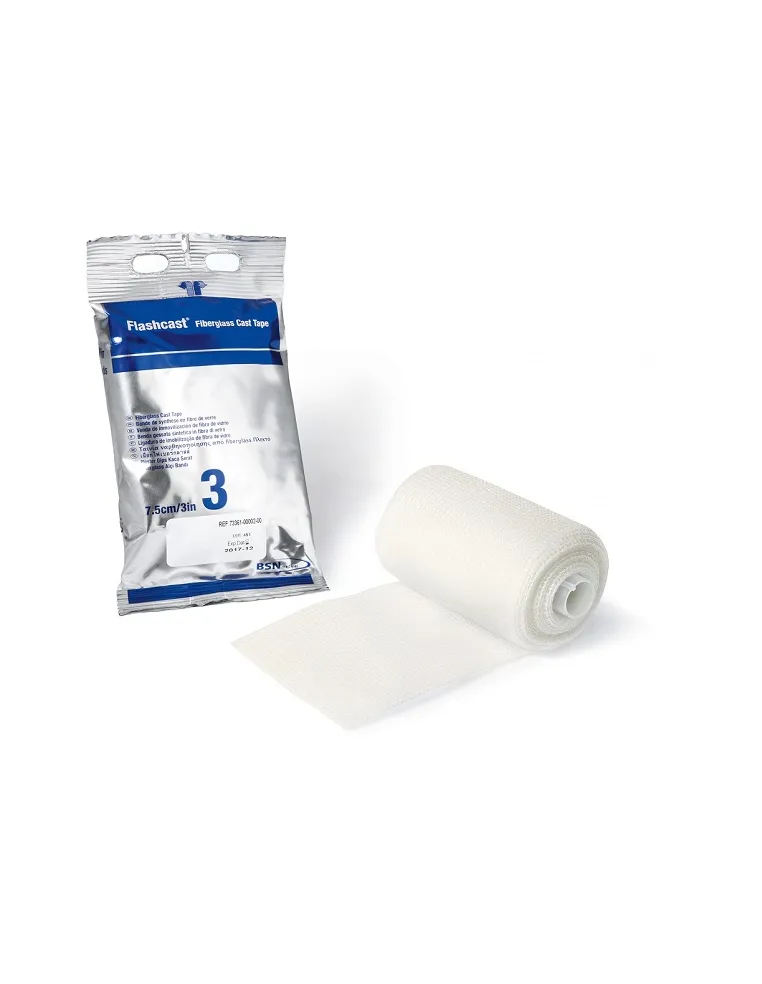



Flashcast Plaster Bandage 10 cm x 3.6 m Equality is a synthetic bandage made of polyester fibers impregnated with polyurethane resin. Designed for the creation of rigid immobilizations, it stands out for its lightness, high resistance and ability to mold perfectly to the limbs or areas to be treated. It provides firm and reliable support, maintaining a perfect fit without excessively compressing the tissues. Thanks to its advanced formulation, the bandage guarantees excellent breathability of the skin and easy and quick application. It does not emit harmful dust during processing, making handling safe and minimizing the risk of allergies. Its dimensions, equal to 10 cm x 3.6 meters, allow it to efficiently cover both large body segments and smaller surface areas, maintaining a uniform distribution of pressure. The bandage becomes rigid within a few minutes of application, allowing the affected area to be quickly immobilized and intervention times optimised. The packaging is designed to preserve its freshness and ensure that the resin does not dry out before use, ensuring reliability on every occasion.
Therapeutic Indications
Indicated for the immobilization of fractures, sprains, joint injuries and orthopedic reconstructions, the Flashcast bandage represents an ideal solution in both hospital and outpatient settings. It is useful in the temporary and definitive management of bone and joint trauma where complete stabilization of the limb or injured area is necessary. In addition to classic orthopedic immobilization, it can be used to treat conditions that require maintaining a specific position for long periods. Its technology avoids the risks related to prolonged immobilization, such as skin maceration, thanks to superior breathability. The ease of modeling makes it particularly suitable for pediatric and elderly patients and in emergency situations where intervention times are essential. It is frequently chosen in post-operative treatment protocols to fix the position of operated limbs, decongest muscle inflammation and reduce the risk of unwanted movements. Its structure also allows it to be used as a rapid removal device, adapting to the clinical needs of frequent dressing changes without sacrificing the stability of the immobilization.
Composition
Main materials: Highly resistant polyester fiber fabric impregnated with water-reactive polyurethane resin. These fibers guarantee strength, adaptability and lightness. The high quality resin gives the necessary rigidity after a few minutes of contact with water and maintains its support properties over time, without losing cohesion or elasticity.
Other components: The impregnation is completed with additives that increase resistance to humidity and durability. It does not contain latex, minimizing the risk of skin or allergic reactions during use by both patients and operators. Free of harmful dust and harmful volatile substances, it allows safe use even in closed environments or with limited air exchange. Packaging takes place in a protected atmosphere to avoid premature hardening due to environmental factors.
Contraindications
Do not use the Flashcast bandage in the presence of open wounds, active skin infections or severe dermatitis conditions on the area to be immobilized. Use is contraindicated in patients with proven hypersensitivity to synthetic materials, in particular polyester and polyurethane compounds. It must be avoided if the presence of significant fluid stagnation following trauma is suspected, which could induce excessive pressure under the splint. Do not apply in subjects with serious vascular disorders, delayed healing or conditions that may be aggravated by rigid immobilization. In the presence of external medical devices (probes, catheters, suture threads), their compatibility must be carefully assessed to avoid risks of compression or injuries. Use is also not recommended in cases of suspected compromises of local circulation where further stiffening could worsen the clinical situation.
Safety of the drug for the species
Flashcast is designed for human use and is specifically designed to respect the skin physiology of adults and children. The plaster bandage maintains excellent performance even on delicate or sensitive skin. During use, safety is guaranteed by the absence of release of irritating or sensitizing substances during and after polymerization. Its fibers do not generate excessive friction, reducing the likelihood of bedsores. Optimal adhesion without creating air bubbles helps prevent the formation of dangerous pressure points. Thanks to the rapid hardening, handling times are minimized, reducing the risk of harmful movements during the fixing phase.
Precautions
It is recommended to use only protective gloves when handling, avoiding direct contact of the polymerizing resin with the skin. The package must only be opened immediately before use to preserve the technical characteristics of the bandage. In case of positioning on reddened areas or fragile skin, it is advisable to place layers of adequate protection between the skin and the bandage. After curing, the bandage should be exposed to minimal ventilation to ensure complete solidification. Be careful not to wet the bandage once it has hardened, unless specifically medically indicated. If you experience pain, edema, cyanosis or changes in sensation, contact a healthcare professional immediately. Disposal must be carried out according to local regulations for medical waste.
Method of administration
To apply the bandage correctly, open the package only before use. Wearing gloves, soak the bandage in room temperature water for a few seconds, then squeeze it lightly to remove the excess. Wrap the bandage over the area to be treated, shaping it carefully. The bandage can be reshaped in the first minutes after application, before the hardening process begins. It is advisable to obtain a uniform wrapping, avoiding excessive overlaps which could compromise breathability. The workability time of the resin is approximately 2-4 minutes; complete rigidity is achieved in less than 10 minutes. Be careful not to overtighten as this may impede circulation. After hardening, check stability and comfort. To remove, use special tools by trained personnel.
Treatment program
Changing the bandage depends on the type of lesion treated, the patient's response and the specialist's indications. In case of recent fractures, the replacement can take place after verifying the correct bone position with radiographic checks. The treatment involves regular monitoring of the integrity of the skin and the state of immobilization, to prevent complications from excessive pressure, vascular or skin lesions. If necessary, the bandage can be removed and reapplied without trauma to the patient. In situations of progressive edema or reduction of swelling, adaptation of the bandage may be required, always under medical supervision. For minor injuries, the duration of immobilization is established based on functional recovery and the guidelines of the healthcare team. The objective is to guarantee maximum support with as little discomfort as possible, intervening quickly in the event of complications reported by the patient.
Target species
Product intended exclusively for human use, both in hospital and outpatient settings, suitable for adults and children who require rigid immobilization of bone or joint segments.