Shopping Cart
There are no more items in your cart
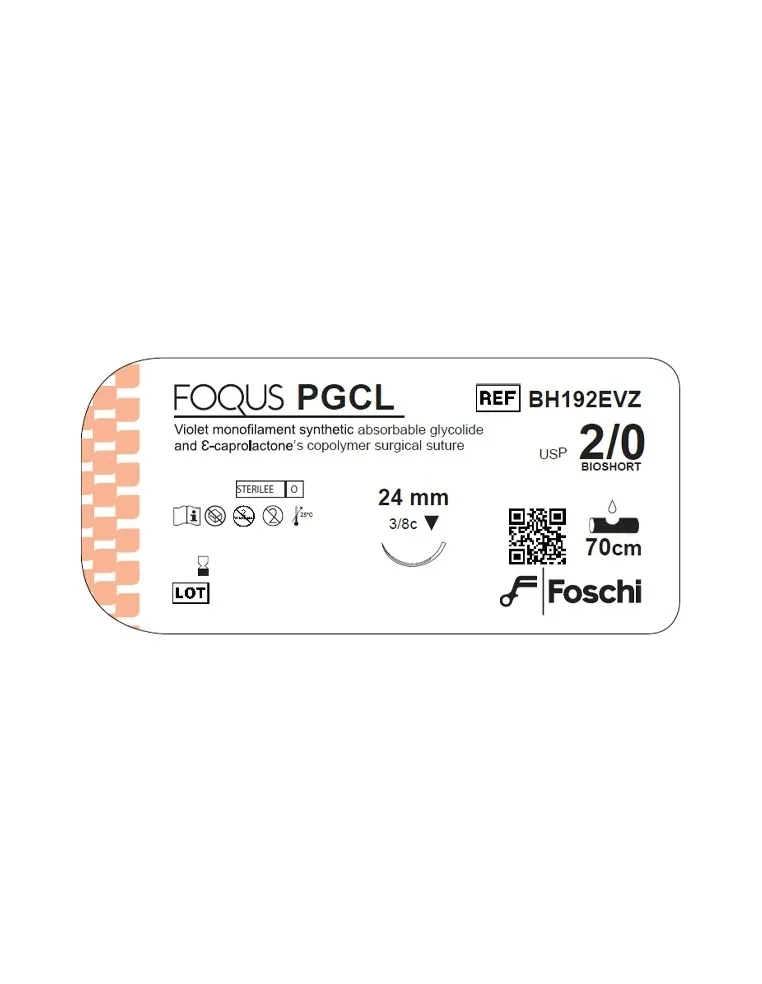
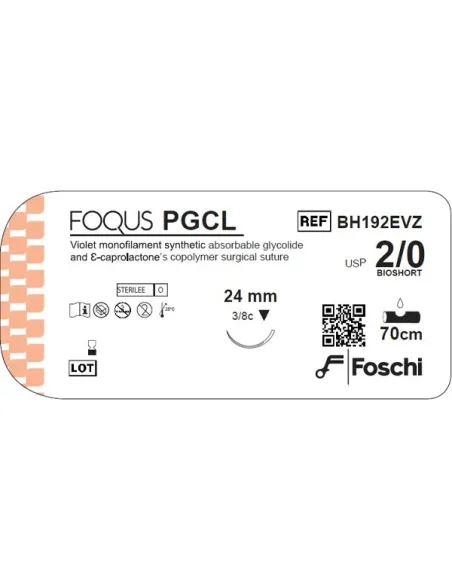


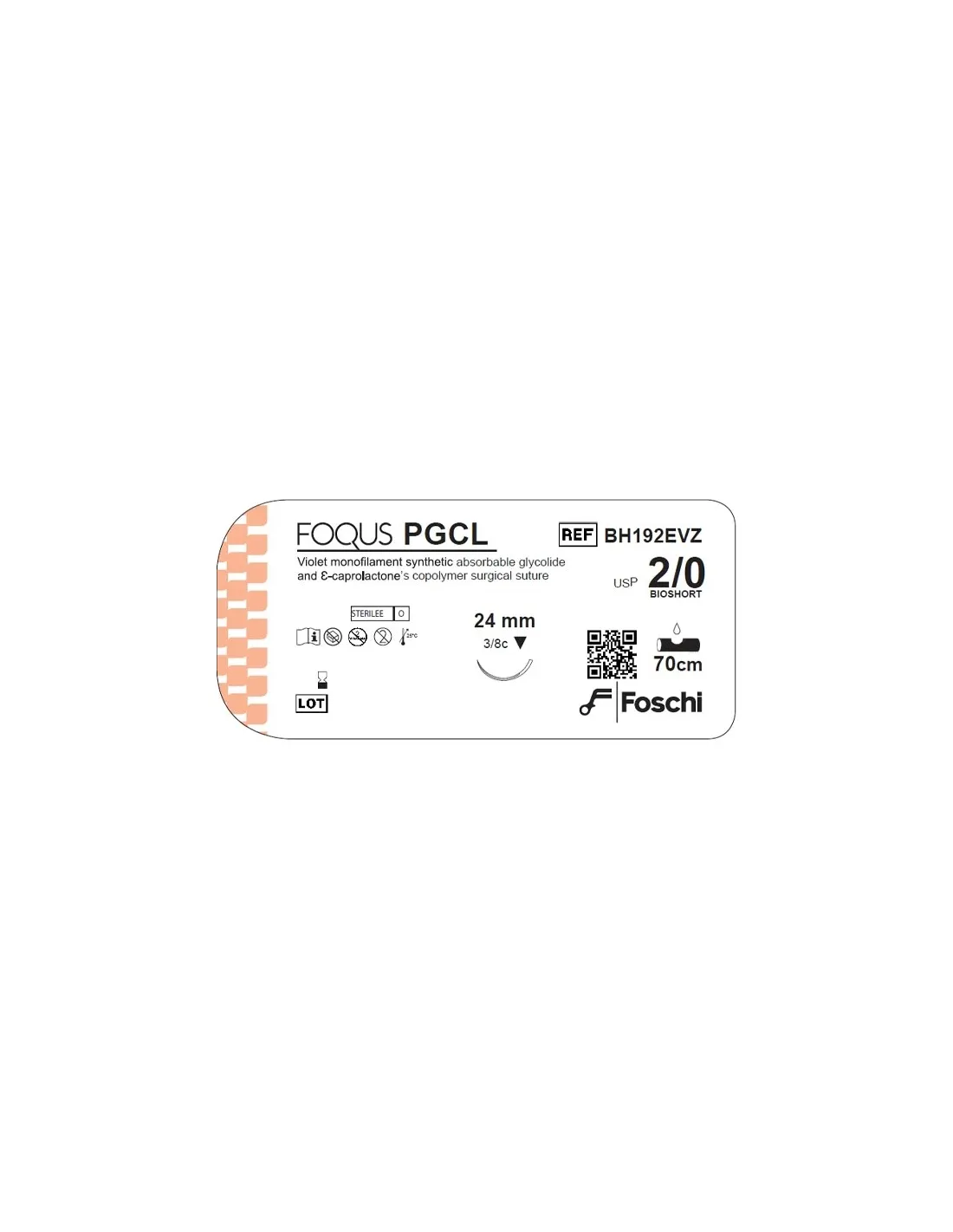
Foqus PGCL USP 3.0 Violent Circular Needle is an absorbable surgical suture thread, developed to offer a safe and reliable solution during surgical procedures that require a suture of temporary duration and high initial strength. The filament, composed of poliglecaprone 25 (PGCL), guarantees excellent handling, flexibility and smoothness during passage through the tissues, minimizing trauma; the circular needle, made with advanced sharpening technology, facilitates penetration even into the most resistant fabrics. Ideal for use in general, gynecological, urological and plastic surgery, this instrument offers a high level of control and precision in soft tissue reconstruction and closure.
The Foqus PGCL USP 3.0 suture is characterized by its initial resistance to breaking load, maintaining the strength essential to support the healing process in the critical phase of the post-operative period. Being monofilament, it significantly reduces the risk of the onset of infections related to the deposit of bacterial plaque between the filaments and the suture material thanks to the smooth and uniform surface. The structure of the thread also ensures the formation of firm and safe knots, reducing the possibility of slipping and guaranteeing a stable hold over time until total reabsorption.
Thanks to the use of synthetic materials, the local inflammatory response is minimal and the hydrolysis process allows a gradual loss of tensile strength, allowing the tissues to reconstruct themselves optimally without the need for removal of the material. The violent circular needle, specifically designed to easily penetrate even the densest and most resistant anatomical areas, helps to reduce operating time and tissue trauma, also improving the patient's post-operative comfort.
Therapeutic Indications
This medical device is used in all those operations where a temporary suture is required and the progressive loss of resistance supported by the thread can be tolerated by the healing tissues. Therefore ideal for supporting healing in general surgery procedures (for example in the closure of abdominal viscera, soft tissues, under the skin), in gynecology for the reconstruction of tissue planes during repair or remodeling operations, as well as in specialized sectors such as urology and plastic surgery. The violent circular needle is particularly suitable where it is necessary to penetrate fibrous or dense tissues such as fascia, muscle or visceral parenchyma. Foqus PGCL USP 3.0 allows for rapid, atraumatic and well-tolerated suturing, making it a suitable choice for the majority of medium-short term surgical interventions in which it is advisable to avoid extraction of the sutures in the advanced healing phase, such as in children, the elderly or patients with mobility difficulties.
Furthermore, the synthetic composition reduces local inflammation and can also be used in patients with a predisposition to allergic reactions to materials of animal origin. It is recommended for subcutaneous suture operations, aesthetic or reconstructive surgery and procedures where a good aesthetic result is important, since its uniform surface limits residual marks and improves cosmetic healing. In any case, the choice of use depends on the surgeon's clinical judgment with respect to the patient's characteristics, the necessary suture support period and the specific healing modality involved.
Composition
Active ingredient: The suture is made of poliglecaprone 25 (PGCL), a synthetic copolymer made up of glycolide and caprolactone, guaranteeing a highly biocompatible product free of components of animal origin. The polymer composition offers high mechanical strength and predictable degradation through hydrolysis, which gradually transforms the material into harmless compounds that are easily reabsorbed by the body.
The suture thread appears as a monofilament, therefore made up of a single smooth fibre, a characteristic that reduces bacterial colonization and facilitates tissue penetration. The matching needle is produced in surgical steel, subjected to hardening and sharpening treatments that guarantee its durability, the absence of deformations during the passage through the tissues, as well as an unparalleled cutting capacity.
Additional excipients used in the synthesis of the filament are physiologically compatible and the production processes prevent contamination by endotoxins or allergenic substances. It does not contain latex, phthalates or other substances potentially harmful to the body. The material has been tested to reduce the risk of tissue reaction and guarantee maximum local tolerability.
Contraindications
The product should not be used in subjects with proven hypersensitivity to synthetic polymers such as poliglecaprone (PGCL) or to metals used in needles. Although rare, the allergic reaction can manifest locally with erythema, swelling, irritation or persistent pain at the suture site, events that require immediate removal of the suture and appropriate medical management. The Foqus PGCL absorbable suture is not recommended in procedures that require prolonged tension support for particularly long periods of time, such as in the synthesis of tissues subject to continuous traction or which heal slowly (e.g. tendon or cardiovascular tissues). In such cases, resorption may occur before complete healing, increasing the risk of wound dehiscence.
Do not use in procedures that involve the prolonged presence of suture material in tissues under high tension, such as in major orthopedic fixations or in the restraint of organs subjected to continuous mechanical stress. The use is not recommended in immunosuppressed patients, with severe healing deficits, connective tissue diseases, or in the presence of active local infection. The product is not suitable for the coaptation of tissues that require a definitive and permanent synthesis, as resorption completes its action after a few weeks.
Safety of the drug for the species
The safety of Foqus PGCL USP 3.0 Violent Circular Needle has been demonstrated through preclinical and clinical studies analyzing tissue response and resorption kinetics in various tissue types. The degradation mechanism occurs mainly through hydrolysis, a process that takes place gradually and determines the disappearance of the suture material in a controlled manner, without the release of toxic or harmful substances. Thanks to the completely synthetic formulation, the risk of cross-immune reaction or infection linked to the presence of antigens of animal origin is reduced to minimal values. Studies have shown that, once implanted, the suture induces a modest local inflammatory reaction in the first post-operative days, which tends to decline rapidly as the material is metabolised by tissue enzymes.
The monofilament surface plays a key role in limiting surgical site infections, while allowing faster healing and a reduction in obvious scarring. It is important to underline that complete safety of use is guaranteed only in compliance with the indications and limits of use provided by the surgical guidelines and in patients who do not present pathologies that alter the normal healing processes. In the presence of conditions predisposing to infections or healing failure, it is necessary to carefully monitor the post-operative evolution.
Precautions
When using the Foqus PGCL USP 3.0 suture, the surgeon must take all standard precautions in handling and preparing the normal sterile operating field. It is important to carefully choose the calibration and length of the thread based on the specific needs of the procedure and the anatomical conditions of the patient, avoiding excessive traction during the knotting maneuver which could compromise the resistance of the materials. Needles should be handled with appropriate forceps to reduce the risk of bending or fracture and disposed of properly immediately after use to prevent accidental injury.
It is also necessary to avoid using the suture in the presence of severely infected, necrotic or profusely bleeding tissue, where the material may not maintain its function for the required time. Personnel who come into contact with the device must always use protective gloves and wash their hands thoroughly after each manipulation of the suture and needle. Store the package intact in a cool, dry place, away from direct light and heat sources, until use; do not use the device if the packaging is damaged or opened.
Method of administration
Foqus PGCL USP 3.0 Violent Circular Needle is applied using standard surgical suturing techniques, both open and laparoscopic. The monofilament, particularly smooth, allows fluid passage through all types of fabric without incurring fraying or stretching. It is advisable to create double or multiple knots in the portions at high risk of tension, maintaining a homogeneous compression to facilitate coaptation of the wound edges without a strangulation effect. In the presence of needles with a violent circular curvature, it is advisable to apply uniform traction and maintain the stability of the needle with a firm grip during penetration into the most resistant tissues.
The wire can be used on both superficial and deep planes; the choice of technique (continuous, interrupted, mattress etc.) depends on the type of repair required. Avoid overlapping multiple knots in the same point, in order not to leave excess material which could prolong resorption times. After use, all metal parts must be disposed of according to the safety protocols established by the healthcare facility.
Treatment program
The period of effectiveness of Foqus PGCL USP 3.0 varies depending on the thickness of the tissue and the clinical condition of the patient. Normally, the wire keeps most of its mechanical strength intact in the first two weeks, gradually losing residual strength during the third and fourth week after implantation; complete reabsorption generally occurs within 60-90 days. In interventions characterized by rapid healing, the suture will provide sufficient tension support until the repair is completely consolidated. In the event of the presence of infection, inflammation or in patients with metabolic alterations that modify the speed of absorption, it is advisable to evaluate whether the product is the optimal choice or whether to use threads made of non-absorbable material.
For general and plastic surgery procedures, a single application typically provides the necessary support without the need for future removal procedures. In cases of slow healing or if the need to prolong the tension support is expected, it is advisable to plan periodic follow-up checks to evaluate the tightness of the thread until complete reabsorption.
Target species
This medical device is specifically designed for use in human patients undergoing surgical procedures that require an absorbable suture of medium duration and excellent handling. It can be used on both adults and children, subject to medical judgement.