Shopping Cart
There are no more items in your cart

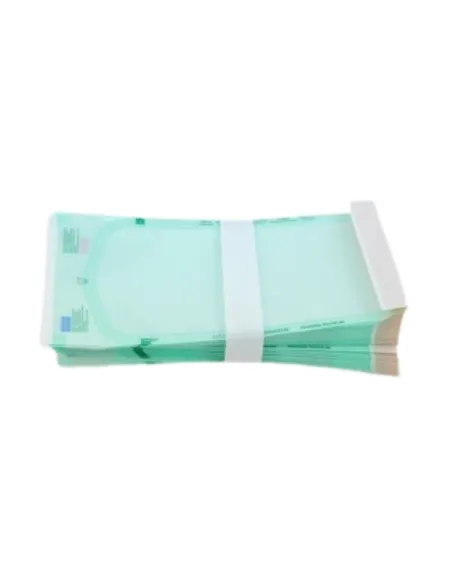


The autoclave bags measuring 90x570 mm represent a practical and reliable solution for the sterilization of medical instruments and materials. Designed specifically for use in autoclaves, these pouches are made to ensure the safety of sterilization both in the dental sector and in other healthcare settings. The 200-piece package allows efficient management of the workload, with the certainty of always having a sufficient quantity of ready-to-use bags for the protection and sterile storage of the instruments until use. The size of 90x570 mm adapts perfectly to intermediate length instruments or assembled kits for surgical and hygiene procedures. The accurate lateral welding together with the multilayer material used in the production of the bag offers an optimal protective barrier against contaminating agents such as bacteria, viruses and dust.
Each bag is equipped with chemical indicators that clearly and immediately indicate the sterilization process has taken place, thus ensuring the healthcare worker an additional element of control for maximum safety. The autoclave bags are simple to close thanks to the efficient adhesive strip and maintain the integrity of the contents during all phases of handling, storage and post-treatment opening. Thanks to the transparency of one side of the bag, you can easily identify the contents without having to open it, reducing the risk of accidental contamination. The elongated format is particularly useful for instruments such as forceps, probes, probes, spatulas and other devices of the same length, ensuring uniform distribution of the sterilizing steam over the entire surface of the wrapped objects.
Therapeutic Indications
The 90x570 mm autoclave bags are intended for all situations where the safe sterilization of medical instruments is necessary, in particular in the dental, surgical and general outpatient sectors. They are indicated for the preparation of surgical sets, the management of instruments in endoscopy departments and for the sterile packaging of reusable medical devices. The use of these bags ensures that each instrument maintains sterility until opening and minimizes the risk of cross-infection due to handling or accidental exposure before use.
The envelopes are also ideal for inclusion in organized workflows, allowing the traceability of instruments thanks to the possibility of noting identifying data directly on the external surface. In many procedures, such as surgical and dental ones, correct sterilization represents an essential requirement for protecting the patient's health and respecting health and hygiene standards; these envelopes are therefore an indispensable tool in modern clinical practices for compliance with international and national guidelines relating to infection control.
Composition
The autoclave bags are made with high quality materials and advanced technology that help ensure an effective microbial barrier. The structure of the pouch generally includes a layer of high-weight medical paper which ensures mechanical resistance and breathability, combined with a layer of transparent plastic film which allows visibility of the packaged instruments. Medical paper is chosen for its ability to retain microorganisms, while still allowing the water vapor necessary for sterilization to pass through. The plastic side, usually made of polypropylene or polyester, is tear-resistant and ensures a secure closure of the bag thanks to heat-sensitive welding. The adhesive used for the closure is free of harmful substances and resists high temperatures, maintaining the integrity of the bag during the autoclave cycle.
There are also sterilization indicators printed directly on the material, based on thermosensitive inks free of toxic substances, which change color once the correct thermal conditions for sterilization have been reached. All materials, including sealants and adhesives, are biocompatible, do not release particles or residues and comply with regulations regarding medical devices and sterilization packaging.
Contraindications
The use of 90x570 mm autoclave bags does not entail any particular contraindications if used correctly and in compliance with the instructions for use. They are not suitable for the sterilization of materials that are not compatible with steam at high temperatures or with the sterilization cycles provided by autoclaves. Avoid using the bag if there is evidence of a loss of integrity, the presence of cuts, tears or damage that could compromise the effectiveness of the sterile barrier. Furthermore, do not use on wet instruments, as the residual humidity could encourage bacterial proliferation if sterilization is not carried out correctly.
Prolonged use or reuse of disposable bags is not recommended: they are designed for a single sterilization application and their reuse, in addition to being ineffective, could expose both the instrument and the operator to serious risks of contamination. In the rare cases of known allergies to the materials constituting the envelope, avoid contact.
Safety of the drug for the species
Being a medical device and not a pharmacological product, the safety of autoclave bags is guaranteed thanks to the careful choice of materials compliant with international regulations regarding sterilization packaging. The sachets are safe for use with medical devices intended for contact with humans and animals, as long as the methods of use and packaging and sterilization instructions are respected. After the sterilization process and during storage, the instruments sealed in the bags remain sterile until opened, drastically reducing the risks of contamination for patients and operators. They do not release toxic substances during autoclave cycles and are also suitable for the long-term storage of sterilized medical materials.
The effectiveness of the sterility barrier is maintained until the moment of opening, provided that there is no tampering or visible damage to the packaging. The transparent material also allows a quick visual check of the status of the instrument without the need to open the bag beforehand, avoiding unnecessary contamination.
Precautions
Before packaging, make sure that the sterile instrument is perfectly dry; the presence of humidity can compromise the maintenance of sterility. Inside the bag, avoid overlapping or excessive forcing which could cause breakages or micro-tears of the structure. Carefully close the adhesive strip, eliminating any air bubbles and making sure that the edges are perfectly adherent. It is important to always use bags of an appropriate size for the instrument, to guarantee the effectiveness of the sterilization process; Bags that are too small can break, those that are too large can compromise the homogeneous circulation of the steam.
During storage, protect the sterilized bags from direct light, humidity and heat sources. Do not overstack envelopes to avoid crushing or accidental damage. When opening, use aseptic techniques to avoid contaminating the instrument. It is good practice to always note the sterilization and sterility expiration date on the outside of the bag, so that you can keep track of and manage the material efficiently.
Method of administration
For correct use, insert the clean and dry instrument inside the bag, being careful not to exceed the maximum capacity allowed and leaving a margin of at least 3-5 cm between the instrument and the closure to allow perfect adhesion of the adhesive strip. Then remove any protective film on the sticker and close by pressing evenly along the entire edge. Once sealed, the bag must be placed in the autoclave with the paper side facing upwards, following the protocols of the sterilization device.
After completing the sterilization cycle, store the bag in a dry and protected place, avoiding bending or crushing. Open the bag only at the time of use, making sure that the chemical indicator has correctly indicated the treatment has taken place.
Treatment program
The envelopes can be used daily according to the operational needs of dental practices, clinics, medical and veterinary practices. It is recommended to carry out sterilization cycles following the instructions of the autoclave manufacturer, respecting the temperature, time and possible pressure foreseen by the validated protocols. Once sterilized, the bags should be used in a rotational manner, so as to ensure constant compliance with the sterility validity times.
The bags must be replaced with each new sterilization cycle: never reuse bags that have already been opened or have already undergone previous sterilization. In case of accidental contamination or damage to the package, it must be replaced immediately to avoid infectious risks. In the case of managing complex instruments or surgical sets, it is advisable to plan the preparation of materials in advance, ensuring the availability of sterile instruments packaged and ready for use as needed at all times, promoting safety and operational continuity.
Target species
The 90x570 mm autoclave bags are mainly intended for instruments used in the dental, surgical, outpatient and veterinary sectors. They can be used with any type of instrumentation intended to be sterilized in an autoclave and have a universal application for the management of reusable material in clinics, hospitals, analysis laboratories, dental practices, veterinary clinics and beauty centers that respect professional sterilization procedures. The choice of the 90x570 mm size is particularly useful for all those devices with an elongated or complex shape that require a length greater than the common envelope, ensuring protection and maintenance of sterility during all phases of management of the instrument itself.